
Talbert Prize for Heritage Justice

The James Marston Fitch Charitable Foundation is pleased to announce the creation of the Mary B. Talbert Prize for Heritage Justice. Established with the generosity of the President’s Fund at the New York Community Trust, this award seeks to strengthen diverse representation in the field of historic preservation by supporting practitioners engaged in innovative work around neglected heritage. The Prize recognizes an outstanding individual working in either traditional or nontraditional preservation practice whose work demonstrates engagement with marginalized stories and broadens collective understanding of traditionally neglected heritage. This award is named after Mary B. Talbert, an early preservation pioneer who, herself, was overlooked as a contributor to historic preservation in the United States.
The Talbert Prize for Heritage Justice recognizes the creative and positive potential of individuals with fellowship funding that, unlike other Fitch grants, is not conditional upon the completion of a new project. Rather, the annual award of up to $17,500 seeks to support ongoing and upcoming creative work by talented practitioners whose track record demonstrates promise to expand traditional notions of preservation and cultural heritage through their pioneering work. An important goal of the Talbert Prize is to broaden the public platform for innovative individuals on issues of neglected heritage, as part of the Foundation’s pursuit to demonstrate the relevance of historic preservation and its utility for social good.
There is no external application process for the Talbert Prize. Nominees are brought to the Foundation’s attention through its Trustees and expansive network of colleagues. Nominees for the Talbert Prize may include practitioners working on the following types of projects:
- Those that identify cultural sites or issues that were previously overlooked by traditional preservation practice and/or Landmark designation standards;
- Those that expand or challenge traditional preservation theory and/or practice, including the standards of designation, conservation and memorialization;
- Those led by new, emerging preservation practitioners or those whose work expands the traditional bounds of preservation practice.
For three decades the Fitch Foundation has played an important role as an incubator of innovation within preservation. By diversifying the community of professionals engaged in preservation, and by encouraging scholarship that extends beyond the boundaries of existing practice, the Fitch Foundation’s Talbert Prize for Heritage Justice can expand the field of historic preservation’s attention to neglected heritage, particularly cultural sites that have been subjected to disinvestment and neglect, or that have been left behind by preservation practitioners because of systemic racism or a restricted view of significance, or a combination of the two.
TALBERT PRIZE AWARDEES

As the inaugural Talbert Prize awardee, the James Marston Fitch Charitable Foundation is thrilled to recognize Tonika Lewis Johnson. Ms. Johnson is a photographer and social justice artist, and lifelong resident of Englewood, a neighborhood on Chicago’s South Side. Her work addresses the systemic and personal consequences of segregation in Chicago. By blending art, advocacy, and community engagement, her initiatives aim to preserve legacies, inspire equity, and foster transformative change.
Ms. Johnson’s seminal Folded Map Project visually examined disparities among “map twins” across Chicago’s racial and economic divides. Her current project, UnBlocked Englewood, focuses on preserving and stabilizing legacy home ownership in one of the city’s most historically disinvested neighborhoods. This preservation approach can be a model for investment in historic homes and fostering community pride in under-resourced communities. Ms. Johnson’s track record of impactful work demonstrates a new vision for what historic preservation can be through the perspective of artmaking and building maintenance.
In 2019, Ms. Johnson was named one of Field Foundation’s Leaders for a New Chicago, and in 2021, she was selected as the National Public Housing Museum’s Artist as Instigator. In 2022, Landmarks Illinois recognized her as a Preservation Influencer.
Tonika was a recipient of the prestigious MacArthur Foundation Fellow Award in 2025.
Read more about Tonika’s work here.
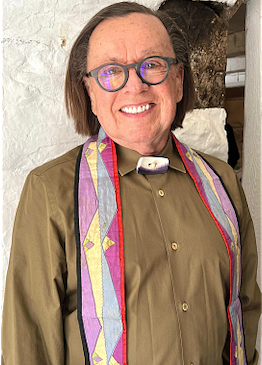
The James Marston Fitch Charitable Foundation is proud to recognize Joe Baker as the second recipient of the Mary B. Talbert Prize for Heritage Justice. Joe Baker is an artist, curator, and culture bearer who has been working in the field of Native Arts for the past thirty years. An enrolled member of the Delaware Tribe of Indians of Oklahoma, Joe is a co-founder and executive director of the Lenape Center based in Manhattan. Spanning multiple mediums, Mr. Baker’s work seeks to preserve and elevate Lenapehoking community, culture, and arts.
Joe Baker’s multidisciplinary approach, combining Native Arts, a curatorial point of view, and the forging of public/private partnerships has brought elevated prominence to Lenape heritage in New York and beyond. Mr. Baker’s approach to “place” takes on added significance, and urgency, in the context of the Lenape diaspora, offering a model for illuminating at-times abstract or intangible elements of cultural heritage preservation.
Mr. Baker has been a key creator in several groundbreaking museum exhibits. As part of the Smithsonian Design Triennial, Joe was commissioned to conceive one of 25 site-specific installations at the Cooper Hewitt exhibit, Making Home, which explored design’s role in shaping the emotional realities of home across the United States, its Territories, and Tribal Nations. Baker also curated the first ever Lenape-curated exhibition of Lenape cultural arts in the City of New York, in partnership with the Brooklyn Public Library. There, Joe placed historic Lenape cultural artifacts in dialogue with similar items created by contemporary Lenape artisans, including himself. Finely beaded Delaware Bandolier Bags dating to the mid-19th century, a time of intense upheaval resulting from the 1830 Indian Removal Act, were paired with contemporary Bandolier Bags produced by Joe – drawing focus to this once important element of men’s attire that had nearly disappeared by the early 20th century.
Outside of his artistic practice, Joe has consulted on Lenape representation within Inwood Hill Park in northern Manhattan, partnered with the Hudson Valley Farm Hub on an ancestral seed rematriation project, and advised design projects including the Inwood Sacred Sites project and the renovation of Tammany Hall by BKSK Architects. His work to build strategic partnerships with New York City institutions and organizations has broadened representation of Lenape arts and heritage in collaboration with the Metropolitan Museum of Art, Brooklyn Museum of Art, American Ballet Theater, and others. Mr. Baker is an adjunct professor at Columbia University’s School of Public Health, a board member for The Endangered Language Fund (CUNY), and member of the Advisory Committee for the National Public Art Consortium, New York.
Read more about Joe Baker and the work of the Lenape Center here.